
“Do you fix a wheel that isn’t broken, or do you wait until the cart collapses?” — Jodi Picoult
During the week beginning Thursday, May 21, 2026, and going over the Memorial Day holiday weekend, our phones lit up with queries from friends and acquaintances about a series of chemical mishaps and disasters that got increasingly worse.
On Thursday, May 21, there was an ammonia release at the St. Louis Area Foodbank. The same day, an incident lasting several days started at the GKN Aerospace plant in Garden Grove, California when a methyl methacrylate (MMA) tank began overheating. Then, just as emergency responders were stabilizing the MMA tank in California, a white liquor tank at the Nippon Dynawave Packaging facility in Longview, Washington failed, injuring eight and killing two, with another nine missing and presumed dead.
What’s going on?
The Ammonia Release in St. Louis, Missouri
Friends here in the St. Louis area wanted to know why a food bank would be using ammonia, would the food at the facility really be safe to eat after an ammonia release, and why the local press was talking about an explosion hazard. Ammonia, among other things, is used as a refrigerant in large-scale refrigeration systems. Although surprised that a food bank would need a large-scale refrigeration system — I thought they focused on non-perishable, shelf-stable foods like canned goods — I am confident that any food would be safe to eat. Ammonia wouldn’t penetrate the cans, and food in a commercial refrigerator wouldn’t be exposed to the ammonia system, which is outside the refrigerator.
As for the news report that ammonia is an explosive hazard? That just seemed to be sensationalism. Admittedly, ammonia has explosive limits from 16% to 25%, which makes it a Category 2 Flammable Gas. With a minimum ignition energy greater than 380 mJ (compared to 0.2 mJ for natural gas) and such narrow explosive limits, ammonia would be very unlikely to result in an explosion. The reporter was simply looking for something to spice up a story that resulted in no injuries, no damage, and only a brief building evacuation while emergency responders shut off the system and ventilated the structure.
The Methyl Methacrylate Tank in Garden Grove, California
MMA is a monomer that exothermically reacts with itself to make poly(methyl methacrylate), generally known as an acrylic. Rohm and Haas originally introduced it to market as “Plexiglas”. That it reacts with itself to form a polymer is what makes it valuable. That the reaction is exothermic means that when an uncontrolled reaction gets underway, it heats up and reacts even faster. At some point, the reaction can become a runaway. There are several measures that can be applied to keep the reaction from starting in the tanks that store the monomer.
At GKN Aerospace, they relied on refrigeration to keep the monomer cool and starting an uncontrolled reaction. When the refrigeration system failed to keep it cool, the stored monomer tank began to heat up. GKN Aerospace alerted emergency responders that they had a developing situation. Unfortunately for GKN Aerospace, their plant is located in heavily populated Orange County, in the midst of a global media capital. So, we all heard about the situation as it developed. Had the MMA tank been located in rural Kansas, the incident would have only been local news.
Eventually, responders were able to stabilize the tank. There were no deaths or injuries. There are lawsuits, however, and the Orange County District Attorney’s Office has launched a criminal investigation.
The Tank Failure in Longview, Washington
The Nippon Dynawave Packaging facility in Longview includes an extensive pulp and paper mill first built by Weyerhaeuser in 1953. The Nippon Paper Group bought the plant and its aging assets in 2016.
One of the steps in converting wood pulp into paperboard is to break down the pulp with hot “white liquor”. White liquor is a highly corrosive aqueous solution of caustic (NaOH) and sodium sulfide (Na2S), with smaller amounts of sodium carbonate (Na2CO3), sodium chloride (NaCl), sodium sulfate (Na2SO4), sodium thiosulfate (Na2S2O3), and calcium carbonate (CaCO3). Hot or not, white liquor will cause severe chemical burns to skin and tissue exposed to it.
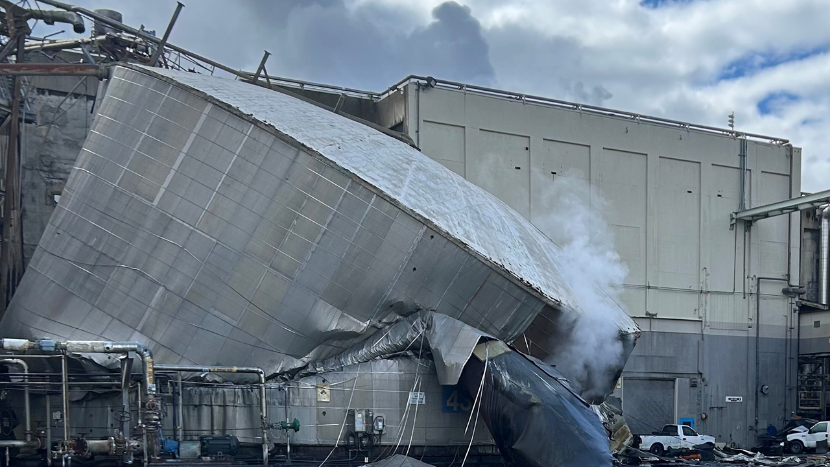
The white liquor tank at the Nippon Dynawave facility had a capacity of 900,000 gallons. When it failed on Tuesday, May 26, it released several hundred thousand gallons of the caustic mixture, a virtual tidal wave.
The incident was initially reported as an implosion, and dozens of news outlets ran with that description. The photographs released by the Longview Fire Department, however, show images that are not consistent with either an implosion (where the tank is sucked in, but remains essentially intact) or an explosion (where the tank is blown out, sending fragments flying). The images are consistent with a collapse, where corrosion on the vessel and its supports finally causes the tank to give way.
The collapse was likely sudden and catastrophic. People in the vicinity would have had little to no warning of the impending disaster.
Implosion or Collapse?
It is important to understand what happened in Longview if we are going to prevent a recurrence. The measures to prevent implosions are different from the measures to prevent collapses.
What causes an implosion? Tank implosions occur when the pressure inside a tank is sufficiently lower than atmospheric pressure. That is, when the tank is under vacuum. What puts a tank under vacuum? One way is to be connected to vacuum system, although that is not the most common cause.
More common is empty the tank, either by pumping it out or by draining it by gravity, without venting the tank at the top. As the liquid leaves the tank, it either pulls in air through a vent, or it pulls in the tank walls. The implosion happens at the top, where there is no liquid to hold the tank walls out.
The most dramatic implosion, however, is when a hot vapor, like steam, is trapped inside the tank, and then cools and condenses, creating a vacuum. There is a famous video, now posted on YouTube by Tom Brattain, of a rail car imploding when the trapped steam inside the car condensed.
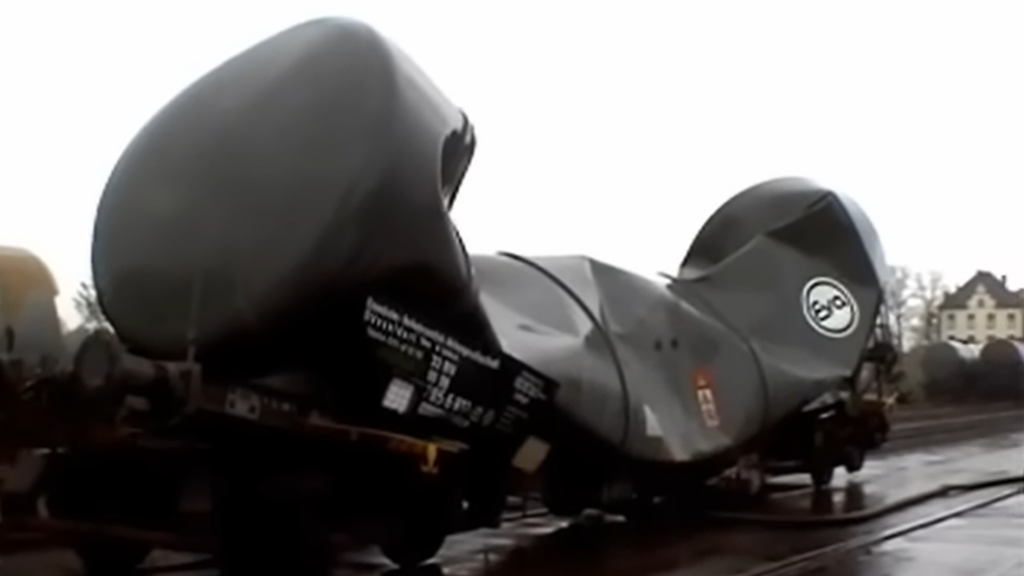
Still from YouTube video posted by Tom Brattain, https://youtu.be/Zz95_VvTxZM
The extent of the tank crumpling depends on the liquid level in the tank when the vapor condenses, but the result almost always resembles that of a crushed beer can.
Regardless of the cause of an implosion, the counter measure is adequate venting on the tank. The age of the tank is immaterial. Brand new tanks will implode if subjected to more vacuum than they are designed to withstand. For atmospheric storage tanks, that is not much.
What causes a collapse? When a tank is exposed to a corrosive material, it loses thickness. Some materials of construction will lose thickness slower than others, but all materials of construction will lose thickness with time. When the corrosive material is introduced in a way that causes it to flow past a spot, not only will there be a general loss of thickness, but there will also be localized erosion.
No tank will last forever. That is why mechanical integrity programs should include routine thickness testing, especially at points where localized erosion is possible or suspected.
The photographs of the tank failure in Longview are consistent with a collapse, especially since the collapse is at the bottom, where the tank was exposed to the greatest hydrostatic forces, rather than at the top, where it would have been exposed to vacuum.
Getting It Right Matters
There is no amount of venting that will protect a tank from corrosion and the resulting collapse. Mistakenly believing the tank failure at the Nippon Dynawave facility was an implosion will lead to inappropriate recommendations that will not prevent a recurrence. Fortunately for all of us, the Chemical Safety Board has already announced plans to mobilize to the incident site. When they determine what happened, they will share it with us so we can all respond appropriately.
In the meantime, let’s all remember that tanks and other process equipment don’t last forever. We need to monitor them, especially as they approach the end of their useful life, and repair them or replace them before they break.
To do otherwise can be fatal.

Leave A Comment