
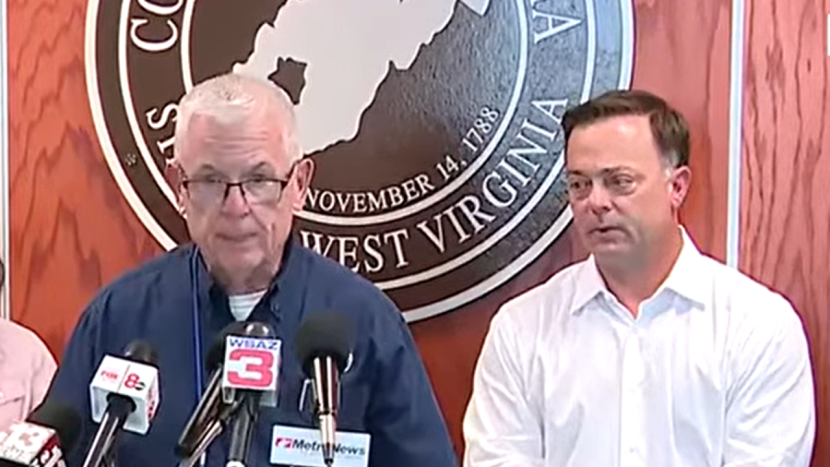
“It was not uncommon; it’s what they do. But there was something going on that was different.” — C.W.Sigman, Director of Kanawha County Emergency Management
At about 9:30 am on Wednesday morning, April 22, 2026, two chemicals reacted to form hydrogen sulfide, a toxic gas, at the small Catalyst Refiners facility in Institute, West Virginia. Exposure to the H2S killed two employees.
Out of an abundance of caution, the local fire chief issued a shelter-in-place order at 9:53 am covering an area extending about a mile from the plant. The shelter-in-place order included the campus of West Virginia State University. Beyond the area covered by the order, several public schools voluntarily sheltered in place. It should be noted, however, that the distinctive rotten-egg smell of H2S was not detected beyond the facility boundaries.
Several people were transported to local hospitals for observation and treatment, including 7 EMS workers who responded to the emergency. One person was admitted to the hospital in critical condition. Additionally, a couple dozen individuals sought medical treatment.
A Release of Hydrogen Sulfide
Catalyst Refiners, part of the Ames Goldsmith Corporation, was in the process of closing down operations at the Institute facility when the incident occurred. Operations included production, warehousing, and offices; they were all housed in a single building. Ames Goldsmith planned to complete decommissioning by June 2026.
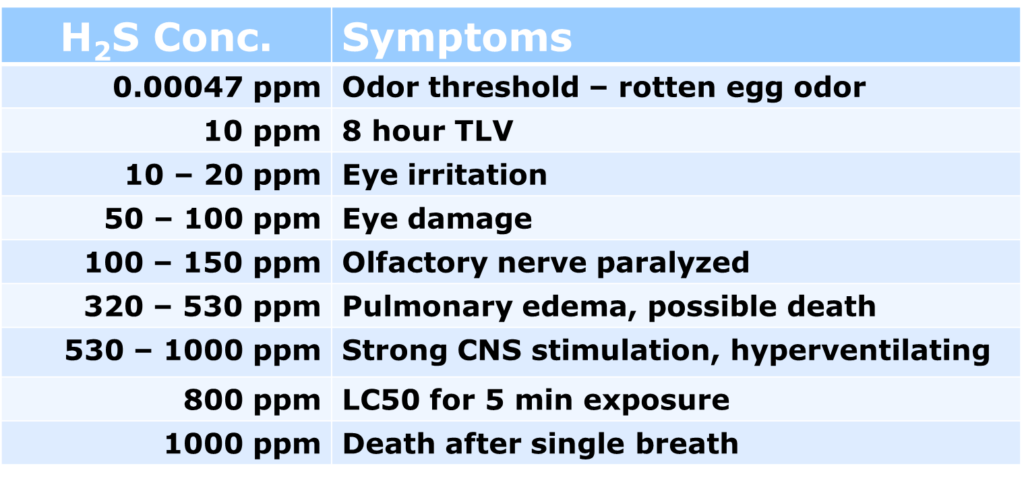
Reportedly, the H2S formed when nitric acid reacted with a chemical called M2000A. Enough formed to reach a fatal concentration in the immediate vicinity of the reaction. A fatal concentration of H2S is not much: just 0.1% by volume. For the two employees that died, the incident was probably over before anyone else was aware that anything had happened.
Getting It Wrong
In the rush to report on the incident, various news media inevitably got many of the details wrong. Some outlets described the shelter-in-place order as a response to a nitric acid release. Some outlets reported the incident as a “spill” (implying that the hazardous agent was a liquid) or a “leak” (implying that the release was slow). The incident was described by some as an “explosion” and “violent”. The H2S gas was described as “fumes”. The dozens of people who sought medical treatment at the local hospital were described as being “hospitalized”.
One thing that is clear, though, is that two workers died. They died doing something that the plant probably considered routine.
OSHA’s Likely Response
The officials in Kanawha County, in addition to their own investigations, are expecting OSHA and the Chemical Safety Board to conduct investigations of this incident. OSHA will decide which of their regulations Catalyst Refiners failed to comply with, convinced as they are that all work-related fatalities can be prevented by complying with applicable regulations.
We can expect that OSHA will look for violations of the Respiratory Protection standard (29 CFR 1910.134) the Lockout/Tagout standard (29 CFR 1910.147), and the Hazard Communication standard (29 CFR 1910.1200). If Catalyst Refiners used nitric acid at a concentration greater than 94.5%, OSHA will also look for violations of the Process Safety Management standard (29 CFR 1910.119). If the exposure was not out in the open, OSHA will also consider the Permit-Required Confined Space standard (29 CFR 1910.146).
While it is possible that regulatory violations led to these deaths and injuries, it is also possible that it was not regulatory violations that led to these deaths and injuries. Nonetheless, OSHA investigations start with the assumption that there are regulatory violations at the root of this kind of tragedy.
Decommissioning Is Not Routine
More valuable will be the response from the Chemical Safety Board. If they are able to investigate (their resources have been cut to the bone and once again, the administration is considering eliminating the CSB entirely), we will all learn what happened so that we can avoid a repeat in our own facilities. Among other things, I expect the CSB to remind us that decommissioning is not routine, that the most dangerous times in a chemical processing facility are during startup, shutdown, and non-routine activities like decommissioning.
Fortunately for the investigation, the CSB investigation is not going to require reconstructing the incident from a debris field. Like neutron bombs, toxic gas releases kill without destroying property.
However, let’s not wait for the CSB investigation report. We already know that startup, shutdown, and non-routine activities are the most dangerous times in a chemical processing facility. Let’s not allow these deaths to be in vain; let them be a reminder to us all.
