
“I think the coop should be held financially responsible to all the residents that were evacuated and cover all costs in the deployment of all emergency personnel!!! A thousand dollars or better per household!!! Payable by the end of next week!!!” – Ron Follis, commenting on the Lincoln County Emergency Management Facebook post
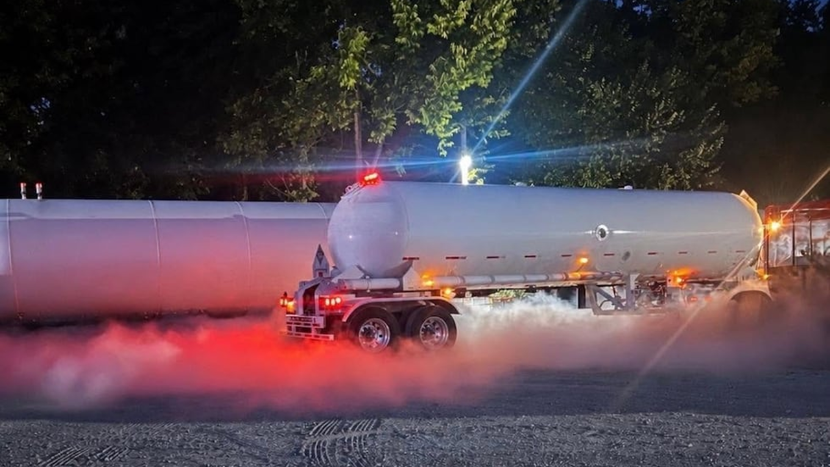
Shortly before 6 am on Friday, September 4, 2026, an anhydrous ammonia truck driver was trying to unload into the anhydrous ammonia storage tank at the Lincoln County Farmers Co-Op just outside of the city limits of Troy, Missouri. (Troy is a small town about 55 miles northwest of Saint Louis.) Then reportedly, a valve in the unloading system failed, initiating a significant release of anhydrous ammonia.
The driver tried to stop the flow, unsuccessfully. Sometime after 6 am, emergency responders from the Lincoln County Fire Protection District arrived, soon to be joined by the St. Charles County HAZMAT Team from the adjacent county, and about a dozen other local and state agencies.
The city of Troy declared a state of emergency and ordered the evacuation of almost 200 homes within a mile radius of the release. By 7:50 am, the responders got the anhydrous ammonia under control and stopped the release. The Troy police department determined after about a half hour that the ammonia vapor cloud had sufficiently dispersed and gave the “all-clear” at 8:12 am.
According to local officials, “the only person injured was a man who was delivering the anhydrous ammonia. That man was taken to hospital. His medical condition was not released.”
The Driver Tried to Stop the Release
While several media outlets made much of the fact that no one in the general public was injured, that doesn’t change the fact that the truck driver was. No employees at the Lincoln County Farmers Co-Op were injured, but the truck driver was. No emergency responders were injured, but the truck driver was. He was injured when he walked into a cloud of anhydrous ammonia in an effort to shut off the release.
Apparently without any protection.
It cost him a trip to the hospital. We don’t know his condition, and because of HIPPA, we’re not likely to find out soon.
That he didn’t die at the scene means that he was incredibly lucky.
When Liquid Anhydrous Ammonia Vaporizes
Producers and distributors ship anhydrous ammonia under pressure so that it remains liquified, typically in the range of 100 psi to 200 psi. The boiling point of anhydrous ammonia is -33.3 C (-28.0°F), so when released to atmosphere, the liquid immediately begins to vaporize. It takes energy to vaporize the liquid, which the ammonia takes from its surroundings. That means that a vaporizing ammonia cloud is very, very cold.
The molecular weight of ammonia is 17.0 g/mole, compared to the average molecular weight of air, which is 29.0 g/mole. Normally, that would mean that ammonia is less dense than air and should float away. Instead, however, the coldness of newly vaporized ammonia makes it much denser than air, so the vapor cloud sinks into low spots. This is compounded by the tendency of the ammonia to react with moisture in the air, making ammonium hydroxide, which has a molecular weight of 35.0 g/mole, and so is naturally heavier than air.
The Effect of Being Enveloped in Anhydrous Ammonia
There are two qualities of anhydrous ammonia vapor that make it especially dangerous for human contact. One is that it is “anhydrous”, meaning that it is free of water. Ammonia is hydrophilic, meaning that it strongly attracted to water. Not just the moisture in the air, but the water in human tissues. Anhydrous ammonia draws the water out of any moist parts of the body—eyes, nasal passages, throat and windpipe—that it contacts. By itself, this contact can cause blindness, chemical burns, and suffocation as the throat and windpipe swell closed.
It’s worse than that, though. Ammonia, and its hydrated form, ammonium hydroxide, are very caustic. It reacts with fats and oils in human tissues to saponify them—to liquify them into soaps. Liquifying tissue is the thing of horror movies and exposure to caustic ammonia.
It’s bad.
What Did the Driver Expect?
What compelled the driver to try to stop the release? Having no opportunity to talk to the him, or to read interviews by others, it’s impossible to know what the driver expected. Did he expect to suffer life-threatening injuries? Or was he unaware of the potential for such harm? Did he expect to successfully shut off the flow of anhydrous ammonia given a failed valve, or was he simply hoping to be able to do it, thinking that to do nothing was unacceptable? Finally, was he simply trying to minimize the amount of material lost, or was he afraid that surrounding neighborhoods would suffer dire consequences if he didn’t do something?
Not knowing what the driver was thinking, it’s impossible to know if the driver was incredibly brave or incredibly foolish. Most are inclined at this point to credit the driver with bravery. Nonetheless, he should have known better and evacuated the scene.
How would he have known better?
The Need for Emergency Planning
The failure of a hose or valve at an unloading station is an easily anticipated scenario. It is not common, but it is not impossible. So, responsible parties should plan for such a scenario and train their personnel on the appropriate measures for responding. The time to decide what to do is not during the emergency itself, but during the emergency planning.
If the trucking company hauling the anhydrous ammonia expected its driver to respond to a release during unloading, then they needed to train him on the response they expected. Perhaps more importantly, they should have provided him with the PPE—respirator and chem suit—to protect him from exposure.
If they expected the driver to evacuate in a release scenario, they should have ensured that he was trained to evacuate. Because there is tendency for heroics during an emergency, this is training that needs to be reinforced often.
As for the co-op, they also needed to be prepared for such a scenario. The Hazardous Waste Operations and Emergency Response (HazWOpER) regulation, 29 CFR 1910.120, requires an emergency response plan for anticipated emergencies. The only exemption is for “employers who will evacuate their employees from the danger area when an emergency occurs, and who do not permit any of their employees to assist in handling the emergency,” but even this exemption still requires an emergency action plan in accordance with 29 CFR 1910.38.
None of the co-op’s employees were reported as being injured. Perhaps it is because at 6 am they simply were not there; perhaps it was because the co-op successfully trained them to evacuate from the danger area; perhaps they were just lucky. Luck, though, is not a safety strategy.
A Release Like the One in Troy Could Happen Anywhere
There are thousands of retail facilities across the country that distribute anhydrous ammonia by filling nurse wagons that farmers then use to fertilize their field. They are constantly unloading and loading anhydrous ammonia. There are also retail sales of other hazardous materials. Any of these can be anticipated to suffer an event similar to the release in Troy, Missouri on September 4, 2026. Each and every one of them needs to consider exactly what they expect to do in such a case.
First responders also need to be aware of the hazardous material in their jurisdiction and be prepared to deal with a similar release. Thankfully for the people of Troy in Lincoln County, Missouri, the HAZMAT team from a neighboring county was ready to respond.

Leave A Comment