
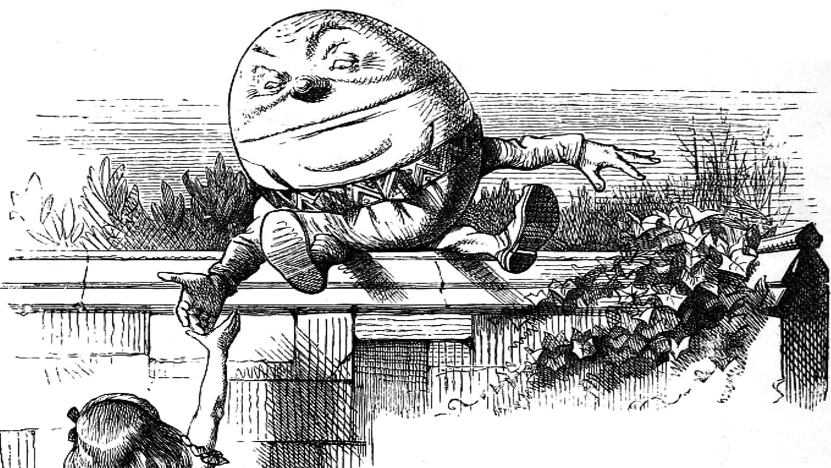
“ ‘When I use a word,’ Humpty Dumpty said in a rather scornful tone, ‘it means just what I choose it to mean neither more or less.’ ” — Lewis Carroll, in Through the Looking-Glass
When Administrative Law Judge Richard DeBenedetto ruled against OSHA in the case of Secretary of Labor v. Meer Corporation (No. 95-0341), he scolded the government with a quote by Humpty Dumpty from Through the Looking-Glass by Lewis Carroll. Judge DeBenedetto said “that the exemption language and process definition as it applies to the exemption are so vague and uncertain as to be insufficient to warn Meer that it was required to comply with the PSM standard.” The judge’s point is that while language, particularly the English language, is flexible, there is great potential for miscommunication when there is not a common understanding of meaning.
A phrase that has appeared several times recently in the context of process safety is “highly volatile.” The writers toss the phrase into a discussion of hazardous chemicals to signal that a particular material is especially dangerous, but what does “highly volatile” really mean?
Dictionary Definition
There is generally no disagreement on the meaning of the adverb in that phrase. While “highly” sometimes means “favorably”, as in “she thought highly of him,” it means “to a great degree or level”. It’s a word that writers use when they want to follow the stylistic dictum of never using the word “very.”
“Volatile,” on the other hand, has three distinct meanings.
- (of a substance) easily evaporated at normal temperatures
- Liable to change rapidly and unpredictably, especially for the worse
- (of a computer’s memory) retaining data only as long as there is a power supply
When a reporter talks about a “highly volatile” substance, it would be reasonable to conclude that they are applying the first definition. Unfortunately for those of us that prefer precision in our technical terms, they often are not.
What Makes a Substance “Easily Evaporated”
There are two properties that influence how easily a substance evaporates at normal temperatures: vapor pressure as a function of temperature (specifically, boiling point) and heat of vaporization. There are several substances that are shipped as liquids but that have boiling points well below normal temperatures. These include liquid nitrogen (-195.8 C, -320.4°F) and liquid anhydrous ammonia (-33.35 C, -28.0°F). If released to the environment, these substances evaporate quite easily, but writers don’t generally describe them as “volatile.”
Interestingly, boiling point and heat of vaporization are closely related in most cases. Trouton’s rule describes the relationship like this:
ΔHvap / Tboiling = 85~88 J/K/mol
The rule does have notable exceptions, though. Ammonia, ethanol, hydrogen peroxide, and water are each much more difficult to evaporate or boil than Trouton’s rule predicts, while formic acid is much easier to evaporate or boil than Trouton’s rule predicts.
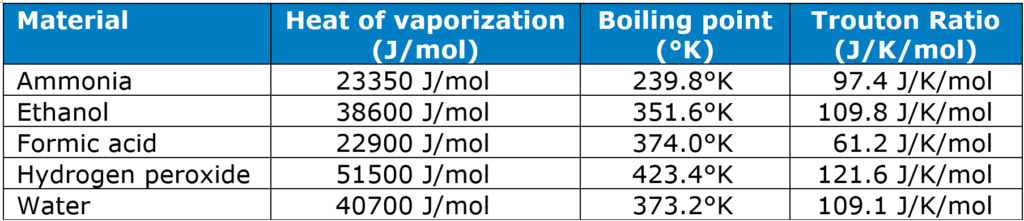
Yet, formic acid is not usually described as “highly volatile.”
Do They Mean “Easily Ignited”?
Some writers may be confused by the multiple meanings of the word, “volatile.” Perhaps they are conflating the second meaning, “liable to change rapidly and unpredictably, especially for the worse,” which refers to people and financial markets, with the first meaning, “easily evaporated at normal temperatures.” From there, they arrive at “easily ignited”.
How easy it is to ignite a material can be described by four properties: explosive limits (aka flammable limits), flash point, minimum ignition energy, and autoignition temperature. Substances that cannot burn have none of these.
Explosive limits describe the lower and upper concentration in air at which a vapor can burn. Below the lower explosive limit (LEL), the mixture in air is too lean to burn. Above the upper explosion limit (UEL), the mixture in air is too rich to burn. The lower the LEL or the wider the range from LEL to UEL, the easier it is to form a flammable mixture.
Flash point (FP) is the temperature at which the material’s vapor pressure is just high enough to form a flammable mixture. That is, enough material vaporizes to form the LEL. Obviously, LEL and FP are related. Lower FP materials can ignite at lower temperatures.
Minimum ignition energy (MIE) is the amount of energy it takes to ignite the vapor at its most flammable concentration in air, which is about midway between the LEL and UEL.
Autoignition temperature (AIT) is the temperature at which a material will ignite spontaneously, even without an ignition source.
For comparison, consider three flammable liquids that have each been described as flammable: acetone, ethanol, and gasoline.

Assuming that “volatile” describes the flammable hazard of a material, then based on everything except UEL, it would be easy to argue that gasoline is the most volatile of the three. Between acetone and ethanol, however, it would be hard to say that one was more “volatile” than the other.
That is why we don’t use “volatility” as a technical term.
Words Matter
When someone is describing a situation, it is important that they use words that everyone else understands. Just because the thesaurus lists “volatile” as a synonym for “dangerous” and “explosive” doesn’t mean that we should use the term when describing technical situations. The term is so vague and uncertain as to be insufficient, and in hazardous situations, understanding matters.
Words matter.
