

“By far, the greatest danger of Artificial Intelligence is that people conclude too early that they understand it.” — Eliezer Yudkowsky
This week at the 22nd Global Congress on Process Safety, my colleague Michael Smith presented a poster on “Getting Safer: The Future of Shipping Hazardous Materials”. His premise was that of all the modes of shipping hazardous materials, shipping by tank truck is the most dangerous—more dangerous than barges, rail, or pipeline—and that just about every hazardous material spends some time on a truck before reaching its final destination.
Worse, shipping by truck is getting more dangerous, not less. Dangerous for the communities through which the trucks pass, dangerous for other drivers sharing the road, and mostly, dangerous for the drivers steering the trucks to their destinations.
Michael argued that if there is going to be improvement in the safety of shipping hazardous materials by truck, it is going to require a change. The change that he argued for was autonomous trucks. Let AI drive the trucks.
Getting More Dangerous
The fatality rate for truck drivers was among the highest for all occupations in the United States. Data from the U.S. Bureau of Labor Statistics shows that it has been getting worse ever since.
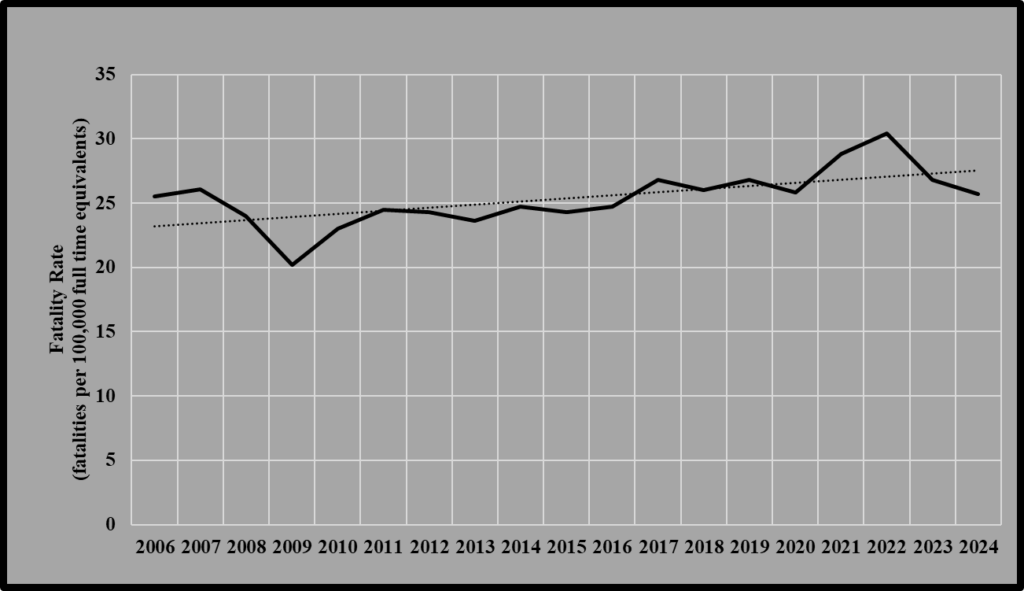
Occupational Fatality Rate for Truck Drivers in the U.S.
According to the Federal Motor Carrier Safety Administration (FMCSA), a part of the U.S. Department of Transportation, the vast majority of truck crashes and hence the vast majority of hazardous material transportation releases, are attributable to driving. Not vehicle failures, which accounted for 10% of truck crashes and not environmental factors, which accounted for less than 3% of the critical reasons for truck crashes.
Factors Leading to Crashes
The FMCSA has identified the factors contributing to crashes that can be attributed to driving.
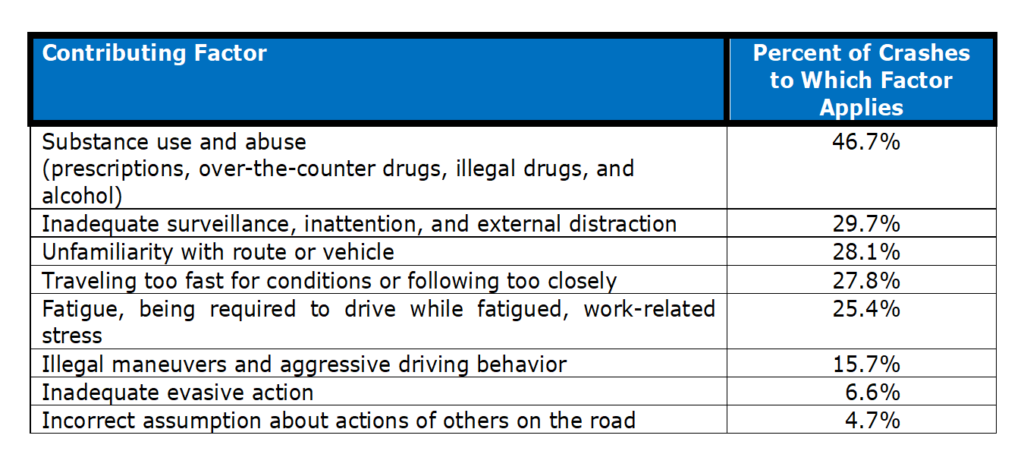
The percentages do not add to 100% because more than one factor can contribute to crashes attributed to driving.
The Case for Autonomous Trucks
Autonomous trucks take the human driver out of the truck cab, which immediately reduces the hazard of truck crashes to the driver. But autonomous trucks also avoid the factors that make other drivers and communities vulnerable to truck crashes.
- Autonomous trucks do not use or abuse prescription drugs, over-the-counter drugs, illegal drugs, or alcohol.
- Autonomous trucks do not get distracted.
- SAE Level 4 Vehicle Autonomy depends on thorough mapping of the routes. So, unfamiliarity with routes will not be an issue
- Autonomous trucks will follow their programming, which will include safe following distances and driving no faster than the posted speed limits.
- Autonomous trucks do not get fatigued or fall asleep.
- Autonomous trucks do not have the emotions that lead to aggressive driving and other forms of “road rage”.
Obstacles to Adopting Autonomous Trucks
Michael identified three categories of obstacles to adopting autonomous trucks: technical, societal, and political.
Technical obstacles:
It is not enough for autonomous trucks to navigate the route in compliance with the rules of the road such as not exceeding posted speed limits, signaling turns, and obeying posted prohibitions like “No Left Turn”. Autonomous vehicles must also successfully share the road with other vehicles, some autonomous but many still human. Unfortunately, human drivers will err in ways that impact the safe operation of vehicles around them, including autonomous trucks hauling hazardous materials.
As progress towards a more automated future continues, we can expect test runs with autonomous trucking systems to continue as well. In all the trials and testing conducted thus far, the cargo transported is largely considered non-hazardous.
Then testing will need to show successful operation of autonomously hauling liquid cargos which will probably involving something familiar to those in the chemical process industry: water batching. Once the act of hauling loaded tank trailers is demonstrated as safe, shippers will want to move on to hauling revenue-producing, but non-hazardous cargos, such as milk.
Only then can we expect to see hazardous cargos hauled.
Societal obstacles:
The public has voiced concerns. Some worry that autonomous driving may leave human drivers out of a job. Currently, however, the trucking industry is experiencing a shortage of drivers. Others are concerned about the need for human support. The support of these systems would extend from driving assistance, maintenance, and oversight to ensure proper operation.
Insurance companies have cited their concerns on developing reliable risk data in order to quote rates for trucking companies and determine payouts for accidents. They worry about having to use different laws as a basis for litigation, e.g., negligence versus product liability law.
Political obstacles:
Wariness from the public makes it more difficult to obtain permission to drive on certain highways, which are legislated and regulated on a state-by-state basis. Some proposed legislation puts the system as a “driver” and makes the owner of the big rig responsible if the “driver” is at fault. Because approval for autonomous trucks will be granted on a state-by-state basis, the rollout is going to be uneven, with a patchwork of legislation and regulations. Ultimately, the federal government will need to intervene with national regulations.
Long-Term Benefits
In the long term, autonomous trucks hauling hazardous materials will be able pick up loads at any location and deliver those loads to any other location that can be reached by truck. Human drivers will not be exposed at all to either the hazards of driving or to the hazards of the materials being hauled. The rate at which hazardous materials are released to the environment will decrease
In order to achieve these benefits, however, it will take support from all sectors engaged in or served by shipping hazardous materials. So, not only the autonomous truck manufacturers and the freight hauling companies, but the facilities in the chemical process industries that ship or receive hazardous materials. The support from the chemical process industries needs to be active, not just passive acceptance.

Leave A Comment