
“The key to good decision making is not knowledge. It is understanding. We are swimming in the former. We are desperately lacking in the latter.” — Malcolm Gladwell
Facilities in the chemical process industries were required to report accidental release events to the Chemical Safety Board (CSB) beginning back in March 2020. These included incidents resulting in one or more fatalities, one or more in-patient hospitalizations, or property damage in excess of $1,000,000. After a slow start (which the CSB expected), reporting began in earnest in February 2021.
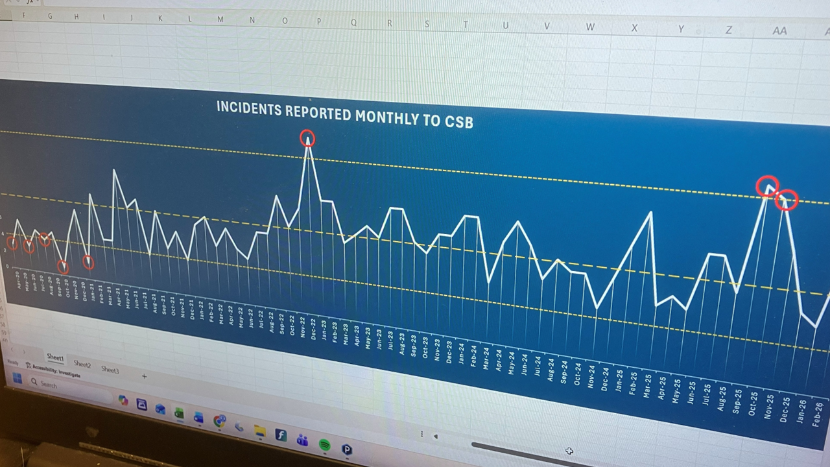
The reporting rate averaged 8.7 incidents per month, excluding the month of December 2022. There were 18 incidents that in December 2022, prompting CSB Chairperson Steve Owens to alert us all to a worrisome spike and the need to focus on winterization to prevent major chemical accidents.
The rate fell back to previous level, however, averaging 9.4 incidents per month from January 2023 through August 2025.
Then, in September 2025, something happened.
Another Spike
Senior Chemical Incident Investigator Dan Tillema spoke at a public business meeting on December 11, 2025, when he disclosed that the CSB received 46 accidental release reports during the three-month period of September-November 2025. He remarked that this was the first time the CSB’s three-month moving average has gone above 14 incidents.
The question and concern about such an announcement was whether the increased three-month moving average represented an upward trend, a step change, or an outlier. Only additional data could answer those questions.
Fortunately, the CSB reports the data from accidental release events on something close to a quarterly basis. The last release of data from the CSB was on March 1, 2026.
A review of that new data trove showed that there was neither a step change nor an upward trend. Instead, the months of September 2025 and October 2025 were outside of the statistical bounds established during the previous 55 months. They were outliers. There were 17 incidents in September 2025 and 16 incidents in October 2025. Or perhaps more relevant, since incidents aren’t constrained to the calendar, there were 34 incidents during the period from September 12 to November 3, or 19.2 incidents per month during that 53-day period.
Then, from November 2025 through the end of February 2026, the incident rate fell back to 9.25 incidents per month – normal.
The data from the CSB consists of the incident date, the company that owns the facility, the location of the facility, and consequences – whether the reporting was the result of fatalities, serious injuries, or substantial property damage. To understand what was different during that 53-day period during the fall of 2025, we need to study the data.
Was There a Difference in the Companies Involved?
Most of the companies that appeared on the CSB’s list during that 53-day period only appeared once. BP, CITGO, and Kinder Morgan each appeared twice, and HF Sinclair appeared on the list three times during that 53-day period.
- In addition to these two times, BP also appeared on the list four times previously and once since.
- In addition to these two times, CITGO also appeared on the list four times previously.
- In addition to these two times, Kinder Morgan also appeared on the list 24 times previously, and twice since.
- As for HF Sinclair: In addition to these three times, the company appeared on the CSB’s list seven times previously.
It is worth noting that of the 29 companies that appeared on the list during this 53-day period, most only once, only five were entirely new to the CSB’s list of accidental release events.
Was There a Difference in the Locations of the Incidents?
Texas was home to 9 of the 34 incidents (26.5%) and Louisiana was home to 4 of the incidents (11.8%). This compares to 140 of 609 incidents overall (23.0%) for Texas and 79 of 609 incidents overall (13.0%) for Louisiana.
Did some state suddenly become a more dangerous place to operate? If anything, the two states contributed less than their share of incidents. Likewise, there were no other significant differences.
Was There a Difference in the Consequences Prompting Reporting?
Regarding fatalities: Of the 34 incidents during this 53-day period, three resulted in fatalities (8.8%). This is about half of the overall, which was 92 of 609 incidents (15.1%) resulting in one or more fatalities. This is curious, and probably worth exploring.
Regarding serious injuries: Nineteen of the 34 incidents during this 53-day period resulted in serious injuries (55.9%), compared to 334 of 609 incidents overall (54.8%) resulting in one or more serious injuries. Whatever the difference was, it wasn’t that companies were suddenly characterizing more injuries as serious.
Regarding substantial property damage (> $1,000,000): Companies reported sixteen incidents (47.1%) during the 53-day period because of property damage. Over the entire span of reporting to the CSB, 292 of 609 incidents (47.9%) listed with substantial property damage. Inflation was not kicking more incidents into the “reportable” category
So, Why?
It is tempting to look back at September and October 2025, to see what was going on that would have prompted two months in a row of high accidental release events. The only thing that stands out is the federal government shutdown. For a couple of weeks, there was the threat of it. Then, on October 1, 2025, the federal government shut down. The shutdown lasted for 43 days. However, it is hard to see why an extended federal government shutdown would prompt a spike in the rate at which the chemical process industries would report accidental release events to the CSB. Malcolm Gladwell, the author of the opening quote, also had this to say: “We have, as human beings, a storytelling problem. We’re a bit too quick to come up with explanations for things we don’t really have an explanation for.”
At this point, we don’t know why there was a spike in the rate during those two months. We need to figure it out, though, if we’re going to understand how to get better.
