
“The greatest enemy of knowledge is not ignorance; it is the illusion of knowledge.” — Stephen Hawking
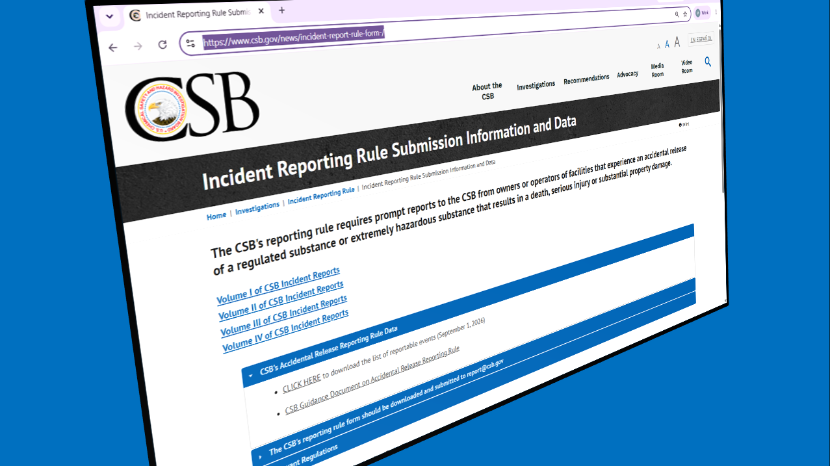
Beginning in March 2020, the Chemical Safety Board (CSB) began requiring that all facilities report all significant chemical releases. That way, they didn’t have to rely on media reports to know what was happening. After a slow start, the chemical process industries—including utilities, food producers, and waste treatment, as well as the usual suspects—began a steady stream of reports in February 2021, at a rate of about 9 releases per month.
It’s been almost six months since I last described what was in the database that the CSB periodically updates and posts on its web site. I thought it would be useful to have another close look and share what has been reported. I was especially interested to see what was new and what had stayed the same.
The States (and Territories) Without Entries Remain the Same
As of April 2026, facilities had nothing to report from four states: Alaska, Hawaii, New Hampshire, and Vermont. Now, six months later and 6 ½ years since the CSB began requiring reporting, those four states still don’t appear on the CSB database. Kudos to the industry in those states. The challenge for the rest of us remains to find out what, if anything, they are doing differently there that the rest of us can learn from.
It is worth noting that there are also three states that have only appeared on the list once. An argon tank exploded at Kittyhawk, Inc., an aerospace manufacturing facility in Canby, Oregon, on 03-Feb-2026, warranting a report to the CSB. On 29-Dec-2023, TRADEBE Environmental Services in Bridgeport, Connecticut was unloading a chemical tanker when it exploded; the resulting injuries prompted a report to the CSB. The last of the three incidents, at the Delaware City Refinery, was on 10-Sep-2020, shortly after reporting to the CSB became mandatory. There have been no incidents in Delaware since.
Interestingly, facilities in U.S. territories are required to report as well. The Limetree Bay Refinery in the U.S. Virgin Islands has reported two incidents. On the other hand, no facilities in Puerto Rico have reported any incidents. This, despite Puerto Rico being more populous than Alaska, Delaware, Hawaii, New Hampshire, Vermont, and almost as populous as Connecticut and Oregon.
The Incident Rate Remains the Same
Since February 2021, the rate at which facilities reported accidental releases to the CSB has been 9.4 incidents per month. The 95% confidence limits for that rate go as low as 4 incidents per month and as high as 16 incidents per month. During the 67 months since February 2021, three months were out of those limits: December 2022, September 2025, and October 2025. None of the last six months have been outside of those limits, although July 2026 was at the very low end with only four incidents.
Two Remarkable Incidents
During the last six months, there were 61 accidental releases reported to the CSB. Yet only two of those incidents received sustained coverage in the national media. One was the tank collapse on May 26 at the Nippon Dynawave facility in Longview, Washington, which killed 11 employees and injured 9 others, including a first responder. The other was the incident at the GKN Aerospace facility in Garden Grove, California five days earlier, on May 21.
Interestingly, when the CSB posted its update on 01-Jun-2026, its list included the 26-May-2026 release at Nippon Dynawave, but not the 21-May-2026 incident at GKN Aerospace. I thought that was curious, but then I thought about the criteria for reporting.
The CSB requires reporting for releases that result in a fatality, and serious injury, or property damage greater than $1,000,000. No one was killed in the GKN Aerospace incident. No one was injured in the GKN Aerospace incident. And while a leaking valve and a crack in the methyl methacrylate storage tank will need to be repaired, the property damage did not exceed $1,000,000. The CSB reporting criteria does not include the number of Los Angeles-based reporters who covered the story, or the number of people ordered evacuated by local fire chiefs.
So, it made sense that the GKN Aerospace incident was not on the CSB list. Now, I wonder why it is.
Learning Why
It has become increasingly clear to me that while the data in the CSB list is interesting, there is not enough there to draw meaningful conclusions. What the data does is serve as a guidepost to a more thorough study of what happened. Which states did or did not have incidents is not as important as why. The rate at which incidents happen is not as important as understanding why there are spikes or dips. The CSB is being starved of resources, so they report what they can. It’s up to the rest of us to figure out the “why”, so we can learn from the experience of others.

Leave A Comment