

“In limits, there is freedom.” — Julia Cameron
There is great comfort in knowing that even the most hazardous substances have safe limits. One molecule of a substance is not enough to be hazardous. However, there is some concentration—especially for gases and vapors—that is too high to be exposed to safely.
A lot of effort has gone into determining those limits and there are several of which we should be aware. What those limits are depends a great deal on the hazard that concerns us. In process safety, we worry about fires, explosions, and toxic releases. Therefore, the hazards have to do with toxicity, flammability, or both.
What Are the Limits and Who Sets Them?
There are five sets of limits of particular interest, each with their own acronyms.
Regarding flammability, the limits are Lower Explosive Limits (LELs) and Upper Explosive Limits (UELs). These are also known as Lower Flammable Limits (LFLs) and Upper Flammable Limits (UFLs). These are not determined by any particular organization, but measured using a recognized method, such as ASTM E-681. These limits are physical properties of the substance. Anyone with access to the right testing method should be able to replicate the limits reported in the literature.
The other four limits are more general. They are based on the judgment of the issuing organization and can be subject to revision.
In the U.S., the Occupational Safety and Health Administration (OSHA) has established regulatory limits for workplace exposure. These are known as “Permissible Exposure Limits” or PELs. OSHA has not set PELs for all substances. (Not even for most substances, to be honest.) For those substances with PELS, it is possible to have as many as three types of PELs. The most common is the PEL-TWA, where TWA stands for “time-weighted average”. This PEL is based on a maximum allowable exposure for workers over the course of an 8-hour workday or a 40-hour workweek.
In some cases, OSHA has also established a PEL-STEL, where STEL stands for “short term exposure limit”. The time period is usually 15 minutes, and because the exposure is for only a brief period, the PEL-STEL is higher than the PEL-TWA. In some cases, OSHA has also established a PEL-C, where C stands for “Ceiling”; the PEL-C is a limit that should never be exceeded, no matter how briefly.
Because PELs are regulatory limits, employers must comply with them. There are three other limits that are more in the nature of being advisory. However, employers should keep in mind that in the absence of an OSHA-dictated PEL, OSHA can use other limits to define a recognized hazard, which may be enforceable on a case-by-case basis under the general duty clause.
Recommended Exposure Limits (RELs) are established by the National Institute for Occupational Safety and Health (NIOSH), a federal agency that is part of the CDC. Occasionally, RELs are lower than PELs. When both exist, the PEL is what OSHA enforces.
Threshold Limit Values (TLVs) are established by the American Conference of Governmental Industrial Hygienists (ACGIH). The ACGIH is a non-governmental organization and owns the copyright to TLVs.
PELs, RELs, and TLVs each address routine exposure in the workplace. Another limit is the concentration that is Immediately Dangerous to Life and Health (IDLH). The IDLH limits are set by NIOSH. Unlike PELs, which define the concentration below which exposure is generally considered safe, IDLH defines the concentration above which exposure is generally considered unsafe. Not surprisingly, there is gap between them.
Some Examples
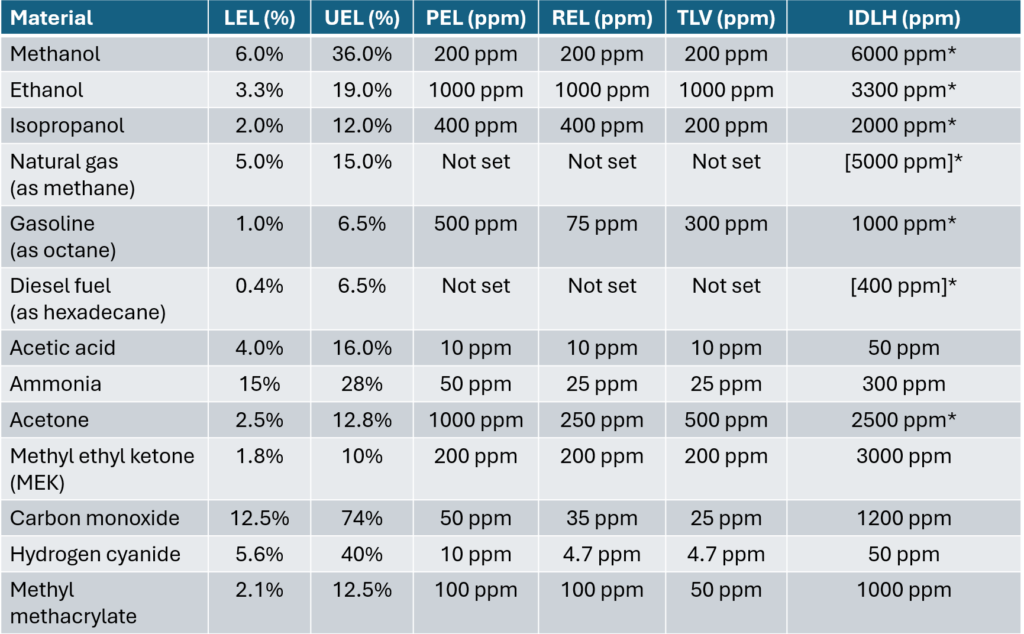
To illustrate the differences between the limits, we selected a few hazardous materials to compare. The list here includes three alcohols: methanol (wood alcohol), ethanol (beverage alcohol), and isopropanol (rubbing alcohol). It also includes three common fuels: natural gas (as methane), gasoline (as octane), and diesel (as hexadecane).
Two chemicals are frequently recommended as “safe” household cleaners: vinegar and ammonia. They are listed here as pure compounds. The table also lists two commonly used solvents that are widely available at hardware stores: acetone and methyl ethyl ketone (MEK). The list also includes two gases with widely recognized reputations for toxicity: carbon monoxide and hydrogen cyanide (cyanide gas). Finally, because of its recent attention in the news, methyl methacrylate is also on the list.
Noteworthy Observations
There are a few things about this short list that are worth noting. While the PEL, REL, and TLV often agree, when they differ, the OSHA PEL is always higher. That is because the OSHA PEL is subject to a political process, while neither the REL nor the TLV are. When they differ, however, the PEL is the limit that is enforceable.
Also, when a material is primarily considered hazardous because of its flammability, NIOSH simply sets the IDLH at 10% of the LEL. When the IDLH is less than 10% of the LEL, that is because its toxicity is more acute than its flammability.
Finally, please note that acetic acid, the active ingredient in vinegar at a 5% concentration, has among the lowest limits on the table; only cyanide gas has lower limits. So much for being a “safe” cleaning solution.
Knowing the Limits
This is just a sample of the information that’s out there. For it to do any good, though, we all have to know the limits, and then live with them.

Leave A Comment