
“Give me a 15-foot crocodile any day over a bee.” — Bindi Irwin
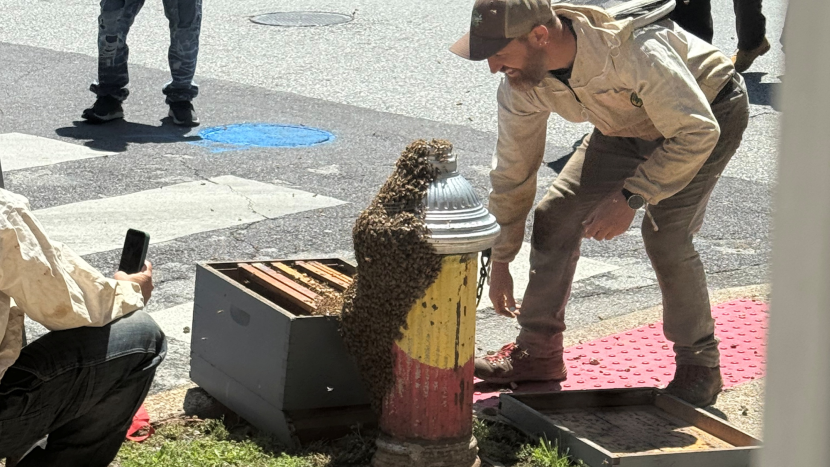
We recently had an unexpected hazard appear outside our office. Unexpected by us, our neighbors, and the Saint Louis Metropolitan Police Department, at least. A hive of bees covered the fire hydrant outside our front door. From across the street, neighbors carefully watched the swarm, as did the police who arrived in three SUVs and a van.
Not long after the police arrived, however, animal control arrived. A couple of apiarists began gathering the bees after first identifying the queen. Eventually, they had all the bees collected.
Disaster averted.
Stings Can Be OSHA Recordable
OSHA considers a sting to be recordable if it is work-related and treatment requires more than first aid. The use of an Epi pen or any other prescription medication qualifies as “more than first aid”. If the sting is at work, OSHA considers it work-related, even if the worker’s job has nothing to do with beekeeping, removing bees, or handling bees. OSHA even considers the use of an Epi pen in anticipation of an allergic reaction to a bee sting to be recordable, even if no allergic reaction happens (presumably because of the Epi pen).
On the other hand, OSHA considers treating a sting with an over-the-counter ointment to be first aid, which would not be recordable.
How Often Do Stings Result in Recordable Injuries
Stings from bees, wasps, and hornets are painful. On occasion, they can require medical treatment beyond first aid. In extreme cases, they result in death. OSHA has a FATALFacts flyer on insect stings that describes one such work-related fatality. Usually, the cause of death is anaphylaxis, where blood pressure drops precipitously and airways narrow abruptly.
The CDC reported that the average number of deaths caused by stings during the eleven-year period from 2011 to 2021 was 72 fatalities per year. Of the fatalities caused by stings, about 10 fatalities per year are work-related. An article published by the Bureau of Labor Statistics (BLS) stated that there were 83 fatal occupational injuries caused by stings during the eight-year period from 2003 to 2010.
Non-fatal stings are far more common, which allows the BLS to report statistically significant data more often. The calendar year survey results for 2023-2024 show in Table R64 that there were a total of 5,920 recordable bites or stings by insects or “bugs” during that period, but that only 260 were in the manufacturing sectors, which include the chemical process industries.
So, while the hazard of insect stings is real, it is not common.
Tracking Insect Bites and Stings in the Workplace
The BLS tracks this data, but for us to find it we have to know where to look. Unfortunately, the BLS often changes its mind about how to categorize insect bites and stings. That categorization is in accordance with the Occupational Injury Illness Classification System (OIICS) in effect at the time.
Until 2012, the BLS used what came to be known as OIICS Manual Vers. 1.01. In that version of the OIICS Manual, an insect sting was categorized like this:
3. Exposure to harmful substances or environment
34. Exposure to caustic, noxious, or allergenic substances
343. Injections, stings, venomous bites
3432. Bee, wasp, hornet sting
So, before 2012, we need to look for bee stings as a harmful exposure as the event.
Then, in January 2012, the BLS issued OIICS Manual Vers. 2.01 as a major revision. In the 2012 version, an instinct sting was categorized like this:
1.Violence and other injuries by persons or animals
13. Animal and insect related incidents
131. Bites and stings
1311. Stings and venomous bites.
From 2012 to 2023, we will find bee stings listed as a workplace violence event.
The BLS issued another major update in October 2023: OIICS Manual Vers. 3.02. In this most current version, an insect sting is categorized like this:
6. Contact incidents
62. Contact with animals
621. Bitten or stung by an animal
6211. Bite or sting – insects, “bugs”
So now, bee stings are contact events.
Although the BLS has adjusted the name and order of categories of events that result in injuries, illnesses, and fatalities, there are still only seven:
- Violent Acts
- Transportation Incidents
- Explosions and Fires
- Falls, Slips, Trips
- Exposure to Harmful Substances, Environments
- Contact Incidents
- Overexertion, Repetitive Motion, and Bodily Conditions
It is probably safe to say that the BLS has tried every category of events that is credible for bee stings. Maybe they are through recategorizing bee stings.
The chart package that the BLS released in January 2026 for the year 2024 includes “Fatal occupational injuries by event or exposure, 2024”. Taking advantage of the drill down feature, we learn that in 2024, there were 13 work-related fatalities resulting from being bitten or stung by animals, i.e., Event 621. We can’t tell if the fatalities were
- Bite or sting – insect, “bugs”
- Venomous animal bite – except “bugs”
- Non-venomous animal bites
In any case, none of those happened in the chemical process industries. The industries with the highest risk of insect bites or stings are farming, construction, and landscaping.
So, What’s the Process Hazard?
If recordable or fatal bee stings are rare in the chemical process industries, then what is the process hazard? Insects, like many creatures, build nests. A favorite place for nests is in open pipes, such as vents or overflow lines. While bird screens can keep birds out of open pipes, bird screens will not keep out insects like bees, wasps, and hornets. The nests of these insects – particularly mud daubers – can be quite durable and capable of withstanding the pressure of venting fluids. Even if the venting fluid is toxic to the insects, their nests can remain.
At the fire hydrant outside our office, one of the apiarists explained that bee swarming behavior is actually quite common in the spring. A large hive splits and a queen bee leaves with about half the hive to start a new hive. Obviously not a good place to start a hive, our fire hydrant was simply a rest stop before they moved on to find their final hive spot. Normally, the apiarists from the city animal control department would not respond to a swarm of bees in the spring. But covering a fire hydrant at the corner of a busy intersection posed an immediate safety hazard, both in terms of passing pedestrians and in terms of the potential need for fire response.
Instead of a fire hydrant, however, a hive of bees could just as easily swarm the outlet of a vent pipe.
While Stings Are Not Frequent in the CPI…
We need to remain vigilant for the hazards of insects. While bee, wasp, and hornet stings are not a frequent occurrence in the chemical process industries, we should remain aware of them. More importantly, however, is the potential for insect nests to disable our vents and other small open pipes. Then, when we discover them, we need to approach them carefully.
