
“Ambivalence is like carbon monoxide – undetectable yet deadly.” — Cherie Carter-Scott
World Fertilizer published an article in its March 2026 issue on “An Overlooked Process Hazard” in the production of ammonia fertilizers. It seems to me that this hazard has broader implications, beyond fertilizer production.
Flammable liquids and flammable gases are all covered by the Process Safety Management (PSM) standard (29 CFR 1910.119) if they meet OSHA’s definition of flammable. Toxic and reactive chemicals, on the other hand, are only covered if OSHA lists them. Appendix A of the PSM standard lists 137 “highly hazardous chemicals, toxics and reactives” that are covered by the standard.
Obviously, there are more than 137 toxic and reactive chemicals, so I wonder sometimes why these chemicals are listed and why others are not listed. The listed chemicals are all hazardous, but one of the criteria for listing is the extent the chemical is used in commerce. For instance, why isn’t ammonium nitrate on the list, given its history of fatal explosions? And why is sarin nerve gas on the list with a threshold quantity of 100 pounds? Is it that widely used?
The one on the list that used to puzzle me, but no longer, is nickel carbonyl with a threshold quantity of 150 pounds. I’m glad it’s on the list. It is a hazard we all need to be aware of.
What Is Nickel Carbonyl
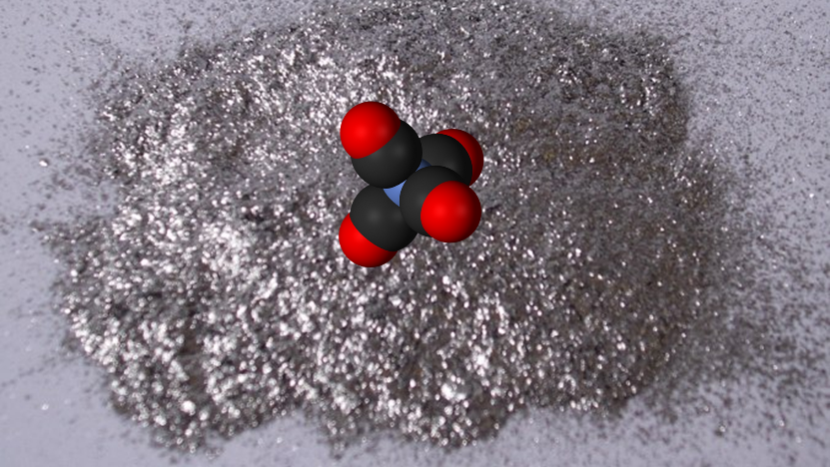
Nickel carbonyl – Ni(CO)4 – is a deadly poison that forms when carbon monoxide reacts with nickel.
Ni + 4 CO ↔ Ni(CO)4
We all know that carbon monoxide is deadly. The permissible exposure limit (PEL) for carbon monoxide is 50 ppm. The concentration of carbon monoxide that is immediately dangerous to life and health (IDLH) is 1200 ppm. Despite carbon monoxides widespread use as a component in syngas, however, it is not listed in Appendix A. Perhaps it doesn’t need to be. As a gas with explosive limits of 12.5% to 74.2%, carbon monoxide is covered by the PSM standard as a Category 1 flammable gas, albeit with a threshold quantity of 10,000 pounds.
Nickel carbonyl, which contains four carbonyl (carbon monoxide) moieties, is not just four times more toxic that carbon monoxide. With an IDLH of 2 ppm, nickel carbonyl is 600 times more toxic than carbon monoxide in terms of being immediately dangerous to life and health. And with a PEL of 0.001 ppm (1 ppb), nickel carbonyl is 50,000 times more toxic in terms of allowable workplace exposure.
A Productive Use for Nickel Carbonyl
Under the right conditions, nickel carbonyl forms by the reaction of carbon monoxide with free nickel. Different conditions force the nickel carbonyl to decompose back into nickel and carbon monoxide. In metallurgy, the Mond Process exploits the composition-decomposition process to first extract nickel from impure material in a gaseous form, then heats the nickel carbonyl gas to force it to decompose, depositing pure nickel and releasing carbon monoxide.
The Mond Process for purifying nickel intentionally produces nickel carbonyl. In other processes where both carbon monoxide and nickel are present, such as nickel-catalyzed syngas processes, or even syngas processes in stainless steel or other nickel alloys, the production of this poisonous gas is quite unintentional.
Conditions Forming Nickel Carbonyl
The reaction of carbon monoxide with nickel to form nickel carbonyl occurs at approximately 50 C to 150 C (approximately 120°F to 300°F). The equilibrium shifts and favors the decomposition of nickel carbonyl back to nickel and carbon monoxide at temperatures above 180 C (356°F).
Wherever there is carbon monoxide and free nickel metal present, nickel carbonyl will form if the temperature is in the right range.
Sources of Nickel in a Process
The most common source of nickel as a reactant for forming nickel carbonyl is the finely divided nickel in sponge nickel catalyst. Even if the catalyst is not a nickel catalyst, it may contain nickel. As Johns pointed out in his excellent piece on the subject, catalyst manufacturers often produce different catalysts in the same equipment, meaning that even non-nickel catalysts may contain traces of nickel.
What about materials of construction? While there is belief that the nickel content of piping and equipment stainless steel and more exotic alloys will not lead to nickel carbonyl formation, that is not true. Work at the Oak Ridge National Laboratory concluded that both iron carbonyl and nick carbonyl form in steel pipes. The amount formed is a function of several factors, gas flow rate and pipe surface area are most important. So, while catalyst is designed to have high surface area and hence a direr concern for nickel carbonyl formation, nickel-containing piping is not without hazard.
Preventing Nickel Carbonyl Formation
It takes three things to form nickel carbonyl: nickel, carbon monoxide, and temperatures between approximately 50 C to 150 C (approximately 120°F to 300°F). Absent any of those three, nickel carbonyl will not form.
Many processes that form or use carbon monoxide operate at temperatures that are too high to form nickel carbonyl. During a shut down, planned or otherwise, when the temperature drops, it becomes imperative to ensure that there is no carbon monoxide present.
For hydrocrackers and hydrotreaters in the petroleum refining industry, Johns recommends maintaining reactor temperatures “above 400°F (200 C) until the concentration of carbon monoxide in the gas flowing through the reactor is below the threshold that will form >1 ppb (0.001 ppm) in the reactor.” He adds “In most reactors, a target CO concentration of less than 10 ppm will ensure that no more than 1 ppb nickel carbonyl can be formed.”
This is good advice for other processes, as well. A target concentration of 10 ppm carbon monoxide is much less than carbon monoxide’s PEL of 50 ppm. It’s the concentration, though, that will keep nickel carbonyl from forming at levels that pose a hazard.
An Overlooked Hazard
To this day, there are personnel in syngas facilities who are unaware of the hazard of nickel carbonyl. Perhaps they have just been lucky. It is much better to learn about this hazard by reading about it than by experiencing it. Nickel carbonyl is a real hazard, but with care and planning, it can be managed.

Highly toxic, volatile—nickel carbonyl is no joke. This video likely covers its severe health effects (lung, neurological) and explosive risks. Essential training for anyone in refining or chemical manufacturing. Recognize the hazard to control the exposure. ☠️🔬 #NickelCarbonyl #IndustrialHygiene